Future Career Trends: Top 20 Careers That Will Be in Demand by 2030
Published 19 Apr 2026 in Explore Careers
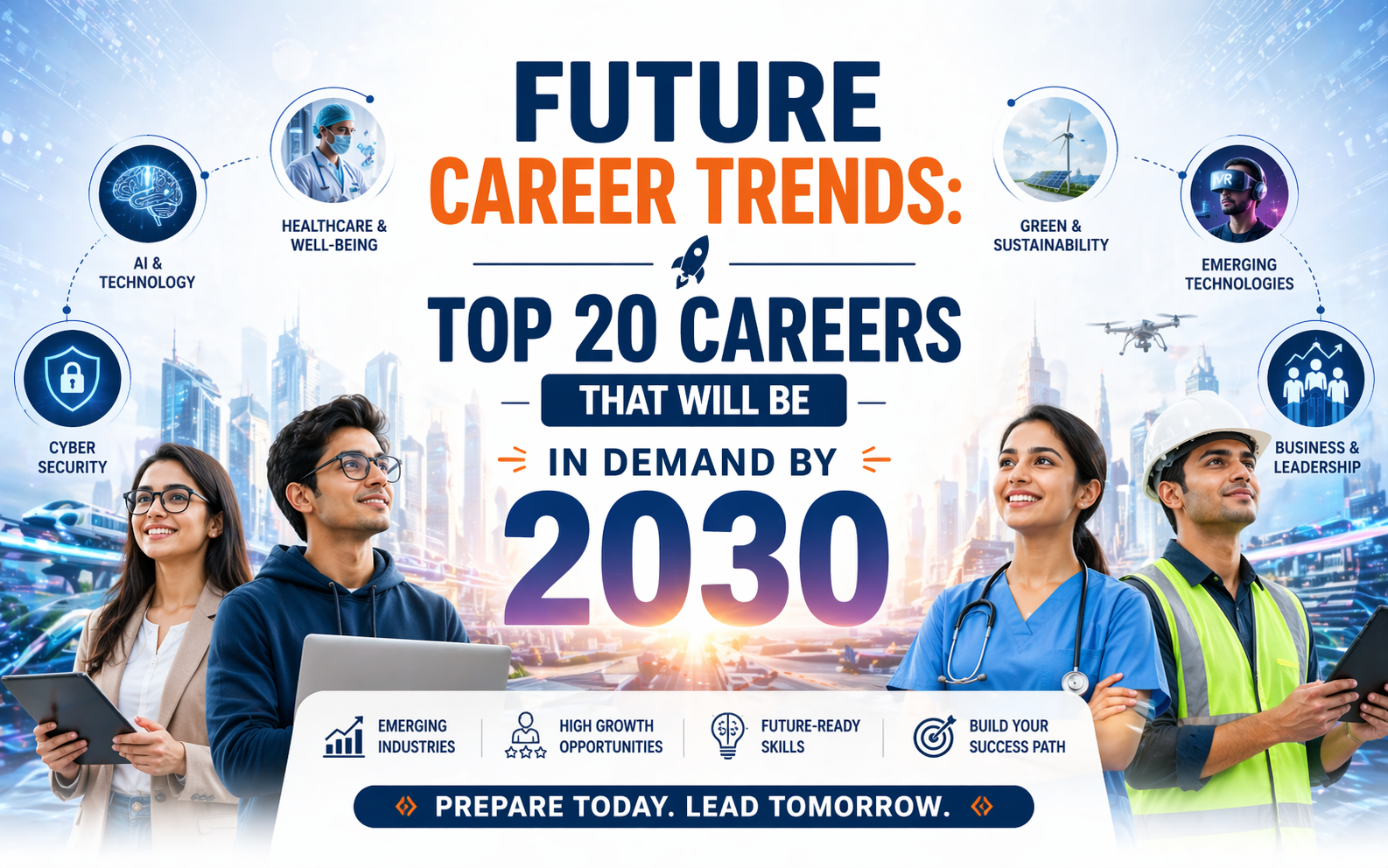
Future Career Trends: Top 20 Careers That Will Be in Demand by 2030
Explore 20 future careers that will be in demand by 2030. Learn key trends, skills, and how students can prepare for a future-ready career.
The world of careers is changing faster than ever.
By 2030, millions of new jobs will be created while many existing roles will disappear or transform. According to the World Economic Forum, 170 million new jobs are expected globally, with a net increase of 78 million roles due to technological and economic shifts (World Economic Forum).
This means one thing:
Students today must prepare not just for a career — but for a future-ready career.
What is Driving Career Demand by 2030?
The major forces shaping careers are:
Artificial Intelligence & Automation
Data & Digital Transformation
Climate Change & Sustainability
Healthcare Expansion
Human-Centric Skills (Creativity, Emotional Intelligence)
Almost 39% of core skills are expected to change by 2030 (LinkedIn).
Top 20 Careers That Will Be in Demand by 2030
These careers are grouped based on global demand patterns and emerging industries.
1. AI & Technology Careers
Artificial Intelligence (AI) Specialist
Machine Learning Engineer
Data Scientist / Big Data Analyst
Cybersecurity Specialist
Cloud Computing Engineer
These roles are among the fastest-growing globally due to digital transformation and AI adoption (Swiss School of Business and Management).
2. Digital & Future Tech Careers
Blockchain Developer
AR/VR (Extended Reality) Designer
Robotics Engineer
Digital Product Manager
Many future jobs will emerge from technologies that are still evolving today (LinkedIn).
3. Healthcare & Well-being Careers
Medical Professionals (Doctors, Nurses, Specialists)
Mental Health Professionals (Psychologists, Therapists)
Healthcare Technologists (Telemedicine, Health AI)
Healthcare demand is rising due to aging populations and lifestyle changes (Dream Studies Abroad).
4. Green & Sustainability Careers
Renewable Energy Engineer
Environmental Scientist
Sustainability Consultant
Climate transition is a major job creator, especially in energy and environmental sectors (EURES (EURopean Employment Services)).
5. Business & Leadership Careers
Business Analyst
Product Manager
Digital Marketing Strategist
Even in an AI-driven world, strategic decision-making and leadership remain critical (Dream Studies Abroad).
6. Human-Centric & Social Careers
Educators & Skill Trainers
Social Workers & Community Specialists
Human-focused roles are difficult to automate and will continue to grow (EURES (EURopean Employment Services)).
Key Insight: Not All Future Careers Are Tech-Based
A common misconception is that only tech jobs will dominate.
In reality:
Healthcare
Education
Skilled trades
Social impact roles
will remain equally important.
The future is not about replacing humans — it is about enhancing human capabilities with technology.
Skills That Will Matter More Than Degrees
By 2030, employers will focus more on skills than just qualifications.
The most important skills will be:
Analytical thinking
Problem-solving
Creativity
Emotional intelligence
Digital literacy
What This Means for Students
The biggest mistake students make is choosing careers based on current trends.
Instead, focus on:
Adaptability
Continuous learning
Understanding your strengths
Because many future jobs may not even exist yet.
Final Thought
The future of careers is not uncertain — it is evolving.
Students who:
Understand themselves
Build relevant skills
Stay adaptable
will have more opportunities than ever before.
Take the Next Step
Choosing a future-ready career is not about guessing trends.
It is about understanding where you fit in that future.
A structured career assessment can help:
Identify your strengths
Match you with future career paths
Give clarity in a changing world
Because the best careers of 2030 will not just be chosen — they will be prepared for.